Southern Alberta's Vaccine Gap: Faith, Fear and the Law
Ezekiel Stephan died in 2012 in the corner of Alberta where childhood vaccination rates are the lowest in the province. Thirteen years later the same region carried Canada's worst measles outbreak in decades. Who refuses vaccines there, and why, what happened to parents whose children died, what the law allows, and where the premier stands.
Jump to: The Stephans' community · The numbers · What the faiths say · Parents in court · The law · The premier
The short version
- Two different kinds of refusal. A few small, insular faith communities in southern Alberta have declined vaccines for generations. Separately, the alternative-medicine and anti-vaccine movement, which the Stephan family belongs to, rejects vaccines on "safety" and "freedom" grounds. The two overlap in the same region but are not the same thing.
- The Stephans' own church supports vaccination. The family attends the Church of Jesus Christ of Latter-day Saints, whose leaders have urged members to immunize their children since at least 1978.
- In 2025 the region paid the price. Alberta had its worst measles year since 1986, concentrated in the South Zone. A premature baby died. Canada lost its measles elimination status in November 2025.
- Vaccination is voluntary in Alberta, and the province has written the right to refuse a vaccine into its Bill of Rights. But the Criminal Code duty to provide a child with the "necessaries of life" applies to every parent, whatever they believe. Four Alberta families whose children died in 2012–13 ended up in criminal court.
The Stephans' community
The Stephans lived near the village of Glenwood, in Cardston County, close to the Truehope offices in Raymond. Like many families there, they attend the Church of Jesus Christ of Latter-day Saints; a witness at the 2019 retrial described discussion of a "priesthood blessing" for Ezekiel, a typical practice in that church.
It would be easy, and wrong, to blame the church. The Latter-day Saint First Presidency urged members to "protect their own children through immunization" as early as 1978. In January 2021 it stated that the church "has supported vaccinations for generations," and in August 2021 it urged members to get vaccinated against COVID-19, calling the vaccines "safe and effective." In 2021 it added its support for vaccination to the church's official General Handbook.
The Stephans' own explanation points elsewhere. Before his first trial, David Stephan told The Canadian Press he believed they were charged because they did not vaccinate their children, and partly because his family had started a nutritional supplements company. Ezekiel was unvaccinated. The family later sat for an interview with Del Bigtree, the American anti-vaccine film-maker. University of Alberta health-law professor Timothy Caulfield warned in 2016 that David's public claims risked turning the couple into martyrs for the anti-vaccine movement. Their stance comes out of the Truehope and alternative-medicine world documented in our Shawn Buckley profile, not out of their church's teaching.
The numbers
Low vaccination in southern Alberta is not new. A 2014 federal public health report by South Zone medical officers found that only 57.3% of two-year-olds in the zone were up to date on measles vaccine in 2013, against a provincial target of 98%. School rates at age seven ranged from 17% to 100%; the lowest were mainly private schools serving the Netherlands Reformed Congregation, Low German-speaking Mennonite communities and some Hutterite colonies. A 2009 pertussis outbreak started in one of those schools and ran for 11 months.
| Measure | Figure |
|---|---|
| Two-dose measles coverage by age 2, South Zone (2024) | 55.8% |
| Same measure, Municipal District of Taber (2024) | 28.7% |
| Same measure, all of Alberta (2024) | 68% |
| Level needed to stop measles spreading | 95% |
| Alberta measles cases, 2025 (to 2 Oct) | 1,914, with 152 hospitalized and 15 in intensive care |
| South Zone share (June 2025) | 520 of 710 cases |
| Deaths | One premature baby, born with congenital measles after the mother was infected |
The baby's death was announced on 2 October 2025. The Globe and Mail later reported, from freedom-of-information records, that officials had known of it for months while they debated how to classify congenital measles. In each congenital case the province reported, the mother was unimmunized. In November 2025 the Pan American Health Organization revoked Canada's measles elimination status, held since 1998.
What the faiths actually say
Most Christian denominations have no doctrinal objection to vaccination. A Vanderbilt University review of U.S. denominations, widely cited during the COVID-19 era, found that among Christian churches only the Dutch Reformed tradition and Christian Science expressed one. In southern Alberta the reasons differ sharply from group to group, and only one rests mainly on scripture.
Netherlands Reformed and Reformed Congregations
This is the one group whose refusal is genuinely theological. The objection is about divine providence: health and disease are given by God, and preventing illness in a healthy child is seen as interfering with His will. The argument goes back to the Dutch physician Abraham Capadose, who published his objections in 1823. It turns on the Reformed confession of providence (Lord's Day 10 of the Heidelberg Catechism).
A 2002 study of families in southwest Alberta, published in the Canadian Journal of Public Health, found that Dutch Reformed parents drew on the Psalter to conclude that immunization "challenges the will of God," and linked illness to human sinfulness. Some reasoned that a child harmed by a vaccine would be the parents' fault, while a child harmed by disease reflected the Lord's will.
The tradition is not of one mind. In the Netherlands, vaccine coverage among orthodox Protestant churches ranges from over 85% in some denominations to under 25% in the strictest, and some Reformed pastors call vaccines an instrument of God's fatherly care. One Dutch Reformed minister has argued that providence "is not an argument against vaccination." The cost of refusal is documented: polio epidemics in Dutch orthodox communities in 1978 (110 cases, one death) and 1992–93 (71 cases, three deaths), and a measles epidemic in 1999–2000 with more than 3,000 cases and three deaths. That measles outbreak travelled to Canada through family visits: 28 Canadian cases, 17 of them in southern Alberta.
Low German-speaking Mennonites
Alberta's Low German-speaking Mennonite population has grown to an estimated 25,000–30,000, many with roots in Mexico. Community health workers who grew up in it say the hesitancy is rooted less in theology than in memory and mistrust. One recalled vaccine nurses arriving in her Mexican colony with a cooler of vaccines; another said that at the word "vaccine," "people would run and hide," and suggested health staff say "needle" instead. Many adults do not read English, so health information reaches them second-hand.
During COVID-19, the editor of Die Mennonitische Post, a Low German newspaper, described the misinformation reaching Kanadier Mennonites in Manitoba: tracking chips, infertility, end-times prophecy and the biblical "mark of the beast." Alberta Health now runs Low German videos, a Low German helpline and community health representatives; demand for their services rose 25% during the 2025 outbreak.
Hutterite colonies
Hutterites are not uniformly opposed. In the 2002 Alberta study, refusal in some colonies traced back to past adverse reactions, including one case of permanent disability blamed on a vaccine, reinforced by a belief that "God's will" governs children's health and by the use of alternative remedies such as a homeopathic DPT product. Among the Dariusleut, vaccination decisions rested with mothers rather than the church; some Lehreleut members supported immunization.
The alternative-health parents
The same 2002 study had a third group: alternative-health practitioners and the parents who used them. Their objections had nothing to do with scripture. They feared vaccines would weaken immune systems or cause asthma, allergies and autism, worried about aluminum, mercury and formaldehyde, believed natural infection was better, and got much of their information from alternative-health magazines, websites and health food stores. That description, written ten years before Ezekiel died, fits the Stephans far better than any church teaching.
Why the distinction matters
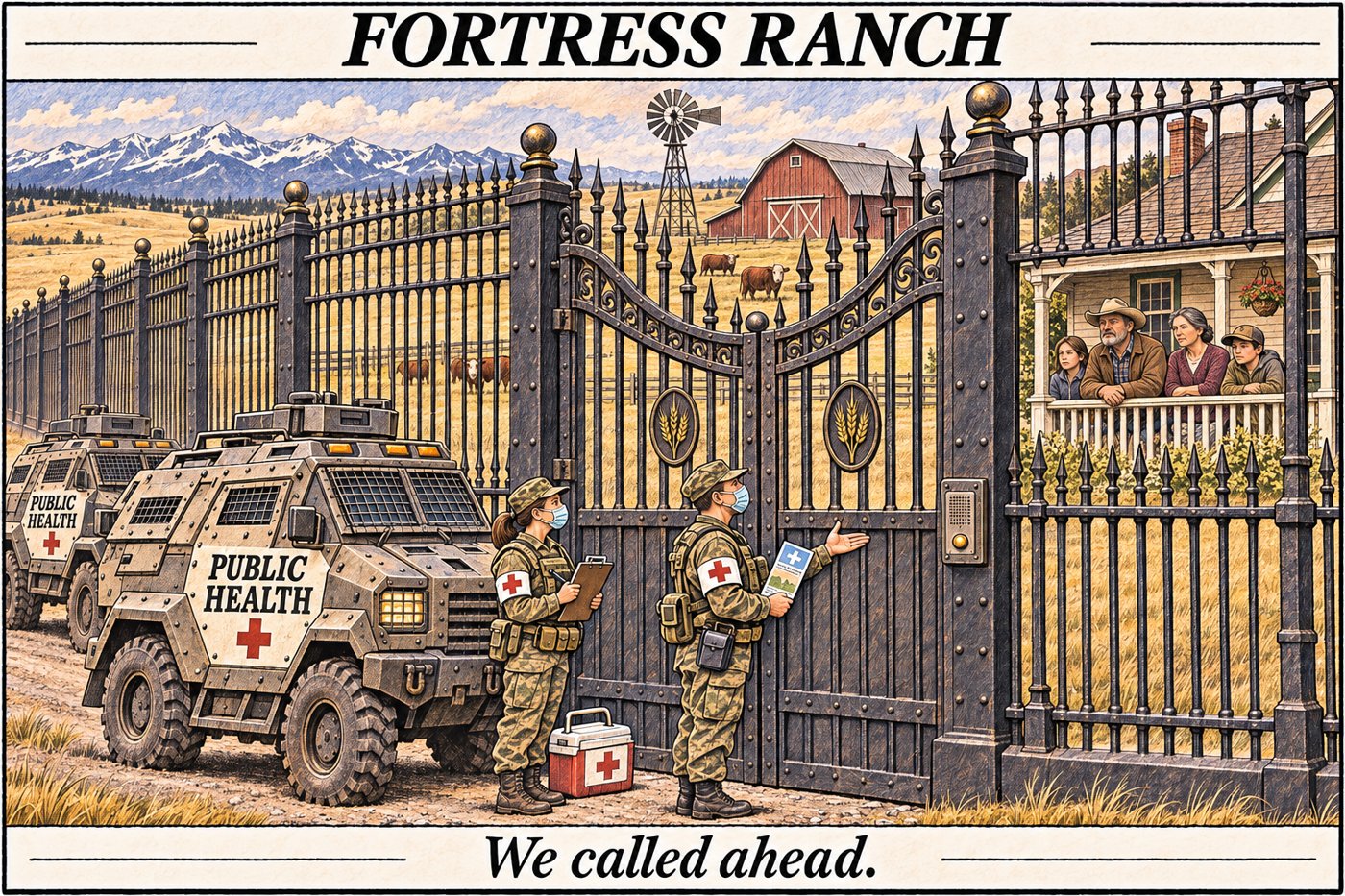
Public health officials in southern Alberta work with church leaders, Low German interpreters and colony bosses, and they report real gains: the province says measles vaccinations rose about 50% in some targeted areas in 2025. Blaming "religious fundamentalists" as a group would undercut that work and miss the bigger target. The fastest-growing source of refusal in Alberta is not an old faith tradition. It is the misinformation and supplement industry that tells parents a smoothie and an immune booster can stand in for a doctor.
Parents in court
No one in Canada has been charged simply for not vaccinating a child. Parents are charged when a child dies or is badly harmed because they withheld medical care. In the space of about 14 months in 2012–13, four Alberta children died in cases that ended in criminal prosecutions.
| Child | What happened | Outcome |
|---|---|---|
| Ezekiel Stephan, 19 months, Glenwood (March 2012) | Bacterial meningitis treated for more than two weeks with home remedies and supplements. | Convicted 2016; new trial ordered; acquitted 2019; acquittal overturned 2021; charges stayed. See the Stephan trials. |
| Ryan Lovett, 7, Calgary (March 2013) | Strep infection treated with dandelion tea and oil of oregano; bedridden 10 days. A doctor testified antibiotics could have saved him. | Mother Tamara Lovett convicted of criminal negligence causing death (January 2017); three years in prison. She later told the parole board she had abandoned her "New Age" lifestyle. |
| Alexandru Radita, 15, Calgary (May 2013) | Type 1 diabetes left untreated for years; weighed 37 pounds at death. His mother told others God would make him better. | Parents Emil and Rodica Radita convicted of first-degree murder (2017); life with no parole for 25 years. Appeals dismissed; Supreme Court declined to hear them. |
| John Clark, 14 months, Calgary (November 2013) | Never saw a doctor until the day before he died of a staph infection, malnourished; the family had searched online for natural gangrene remedies. | Parents Jennifer and Jeromie Clark convicted of criminal negligence causing death and failing to provide the necessaries of life; 32 months each (2019), upheld on appeal in 2021. The judge noted support from their Seventh-day Adventist church. |
Older Canadian cases follow the same pattern: Christopher Tutton, 5, who died in Ontario in 1981 after his parents took him off insulin; and Lina Atikian of Ontario, whose parents followed an herbalist who told them not to take her to a doctor. In 2016 Alberta's health minister ordered a review of naturopathy regulation after the Stephan verdict.
The family courts are where vaccination itself gets decided. When separated parents disagree, Alberta courts have generally sided with the parent who wants to vaccinate. In a 2021 Lethbridge case the court gave a mother authority to vaccinate her children over the father's objections; in a 2022 Edmonton case a judge gave a mother sole medical decision-making for an immunocompromised boy whose father wanted to consult a naturopath instead.
What the law says in Alberta
- No mandatory vaccination. Childhood immunization is voluntary in Alberta, as in every Canadian province. Alberta has no school-entry vaccination requirement.
- Exclusion during outbreaks. When measles appears in a school, unprotected students and staff can be sent home, typically from five days after the first exposure to 21 days after the last. A 2016 amendment to the Public Health Act let public health match immunization records to school enrolment so it could act faster.
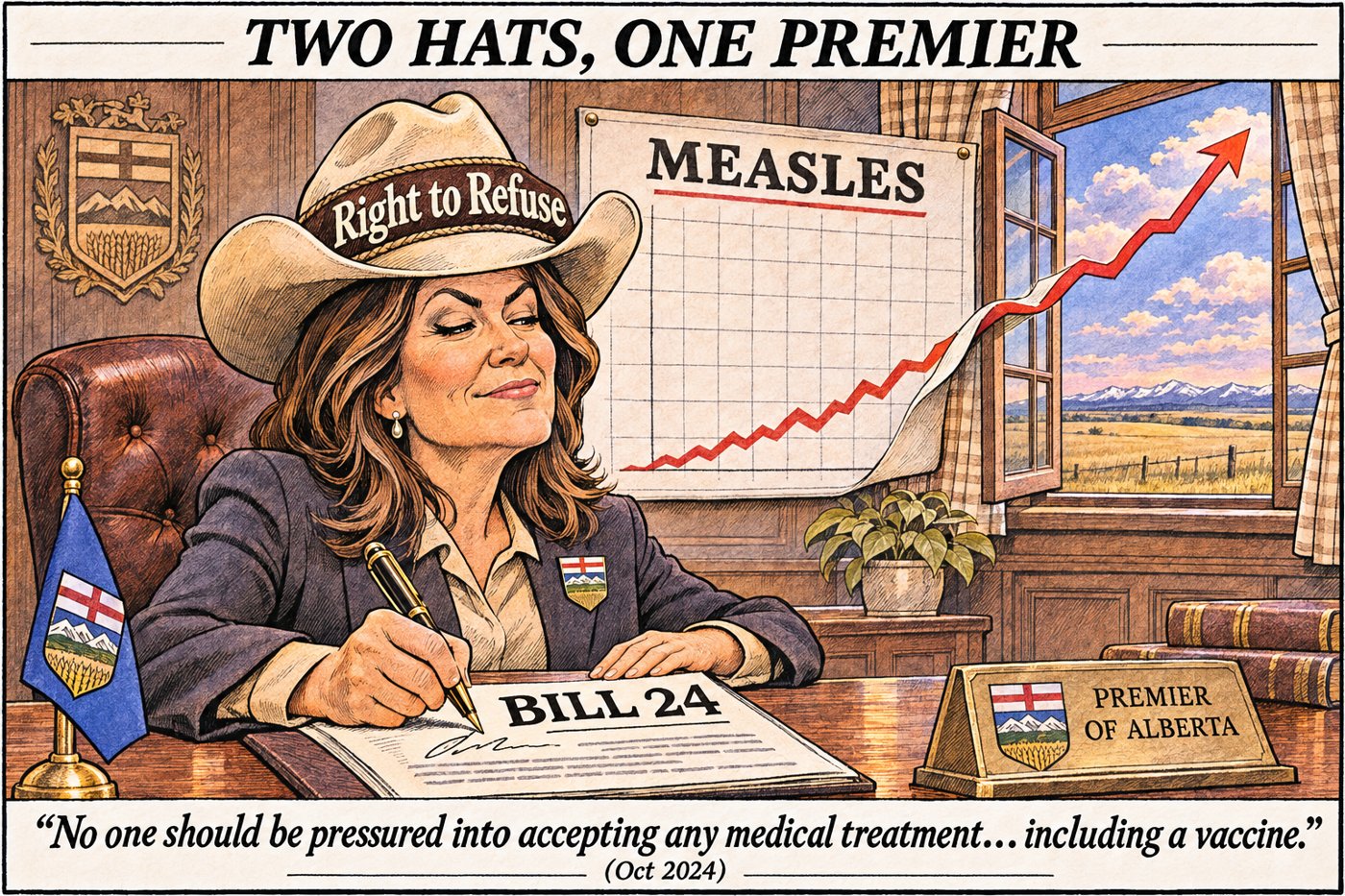
- A right to refuse, written into law. The Alberta Bill of Rights Amendment Act, 2024, which received royal assent on 5 December 2024, added "the right of the individual with capacity not to be subjected to, or coerced into receiving, a vaccine without the consent of that individual." For other medical treatment there is an exception where a person is likely to cause substantial harm to others; the government confirmed that the vaccine right has no such exception. Legal scholars noted the Charter already protects against forced treatment, and that the new right binds government, not private employers.
- The criminal duty still applies. Section 215 of the Criminal Code requires parents to provide the "necessaries of life" to their children, and medical care is one of them. Religious or philosophical belief is not a defence when a child dies for lack of treatment, as the Lovett, Clark and Radita cases show.
- No inquiry into Ezekiel's death. Alberta's fatality inquiry system never examined the case. See why there was never a fatality inquiry.
Does Premier Danielle Smith support immunization?
Her record points both ways, and both should be on the table.
| Date | What she said or did |
|---|---|
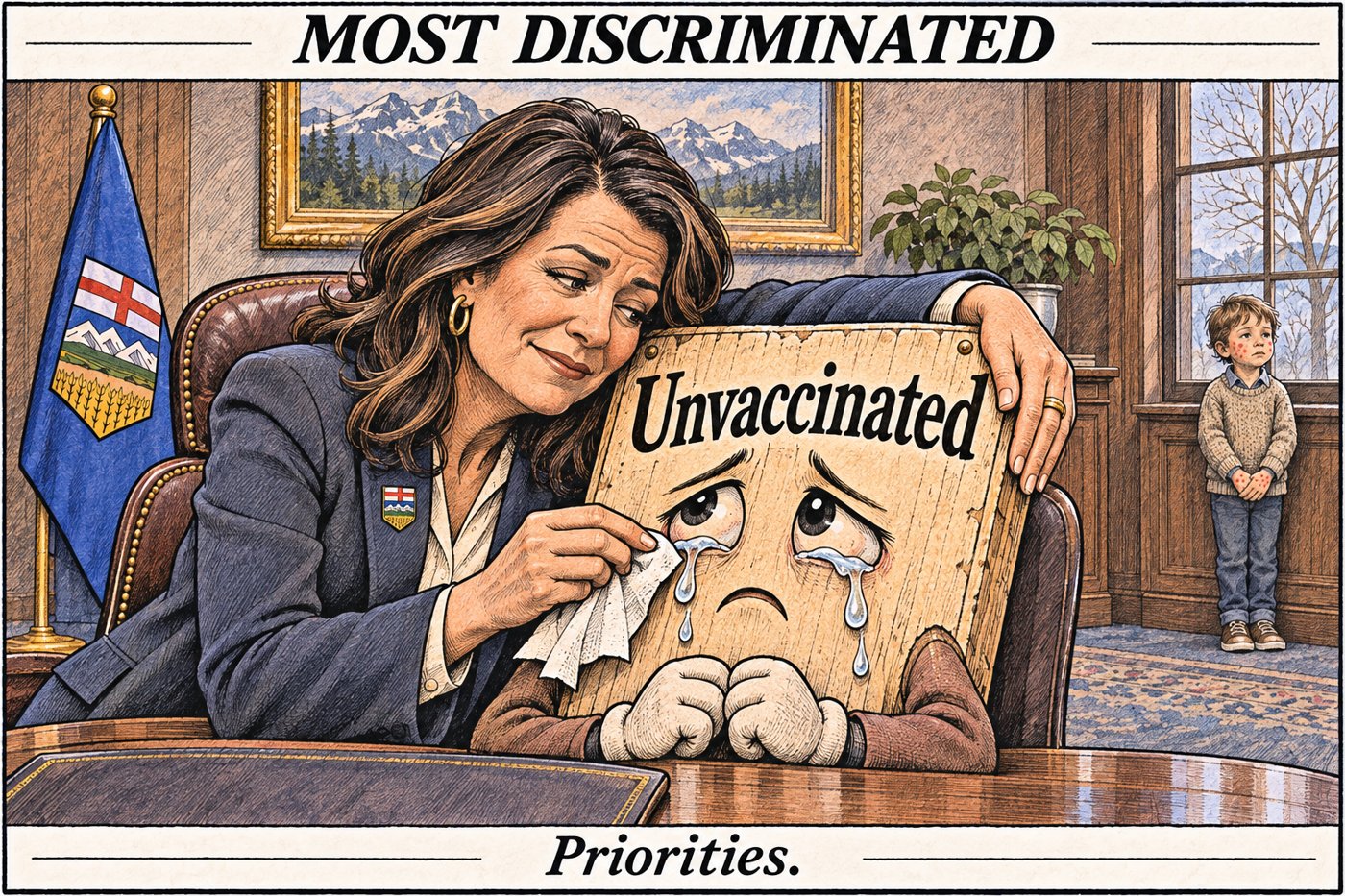
| Oct 2022 | On her first day as premier, called people who chose not to get a COVID-19 vaccine "the most discriminated against group that I've ever witnessed in my lifetime," pledged to replace chief medical officer of health Dr. Deena Hinshaw, and promised to add vaccination status to the Alberta Human Rights Act (she later backed away from that). She issued a clarification but no apology. |
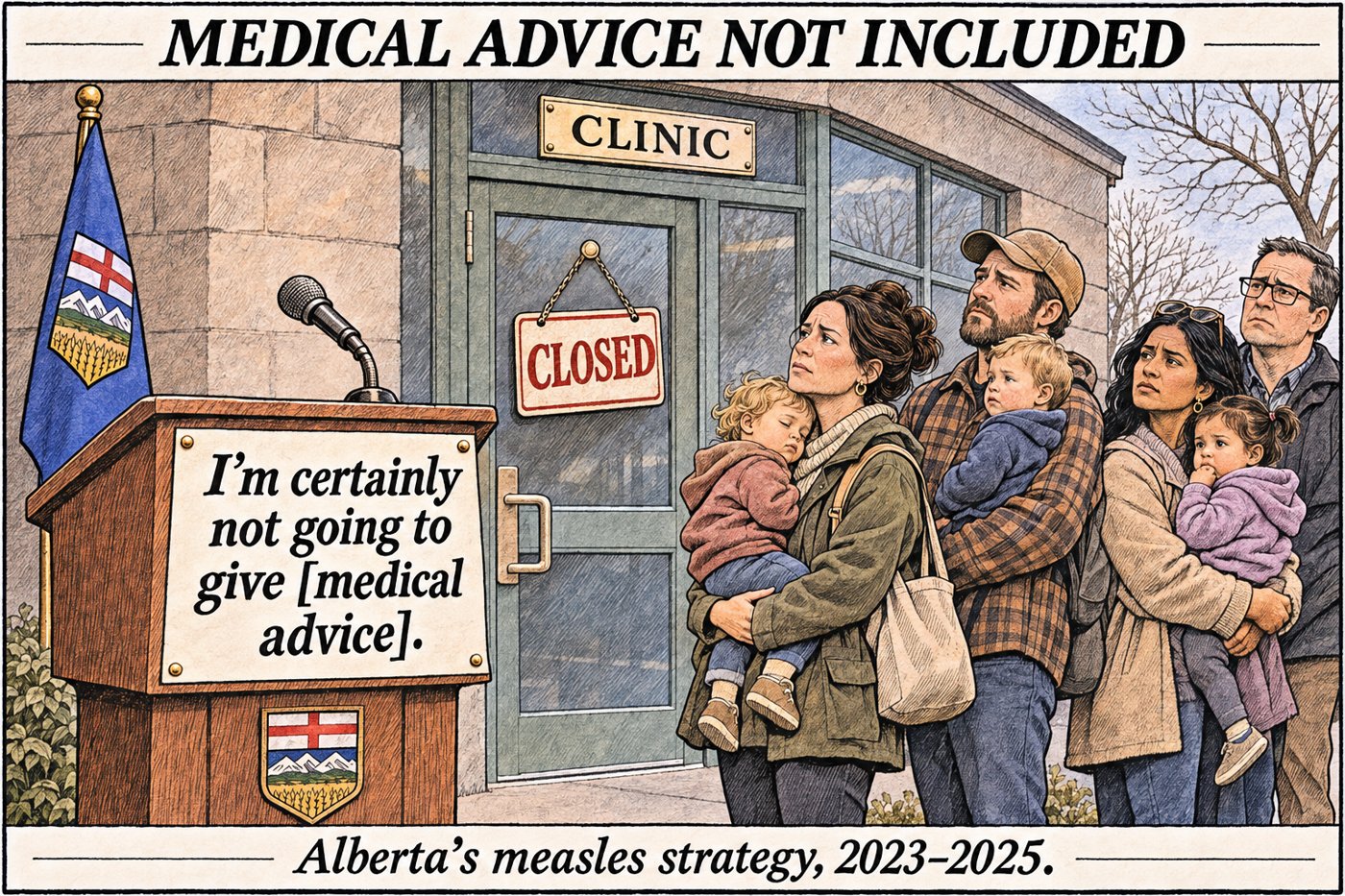
| Nov 2023 | Defended a pared-back fall immunization campaign: "I don't think they go to politicians to get medical advice, and I'm certainly not going to give it." |
| Oct–Dec 2024 | Introduced and passed the Bill of Rights amendment: "No one should be pressured into accepting any medical treatment without their full consent, including a vaccine." |
| Spring 2025 | As measles spread, critics, including a Troy Media column carried by southern Alberta papers, faulted the premier and her appointed chief medical officer for months of public silence. In April her health minister, Adriana LaGrange, launched a campaign: "Don't get measles, get vaccinated." That year Alberta also began charging most adults a fee for COVID-19 vaccines. |
| Nov 2025 | After Canada lost measles elimination status, called the loss "concerning," said measles "can have devastating impacts, especially on young kids," and pointed to targeted campaigns in Mennonite and Hutterite communities that she said raised uptake by 50% in some areas. |
| 2026 | Expanded free RSV protection to all newborns in September after pediatricians pressed for it, and let pharmacies give COVID-19 shots for 2026–27, drawing criticism from the anti-vaccine wing of her own party. |
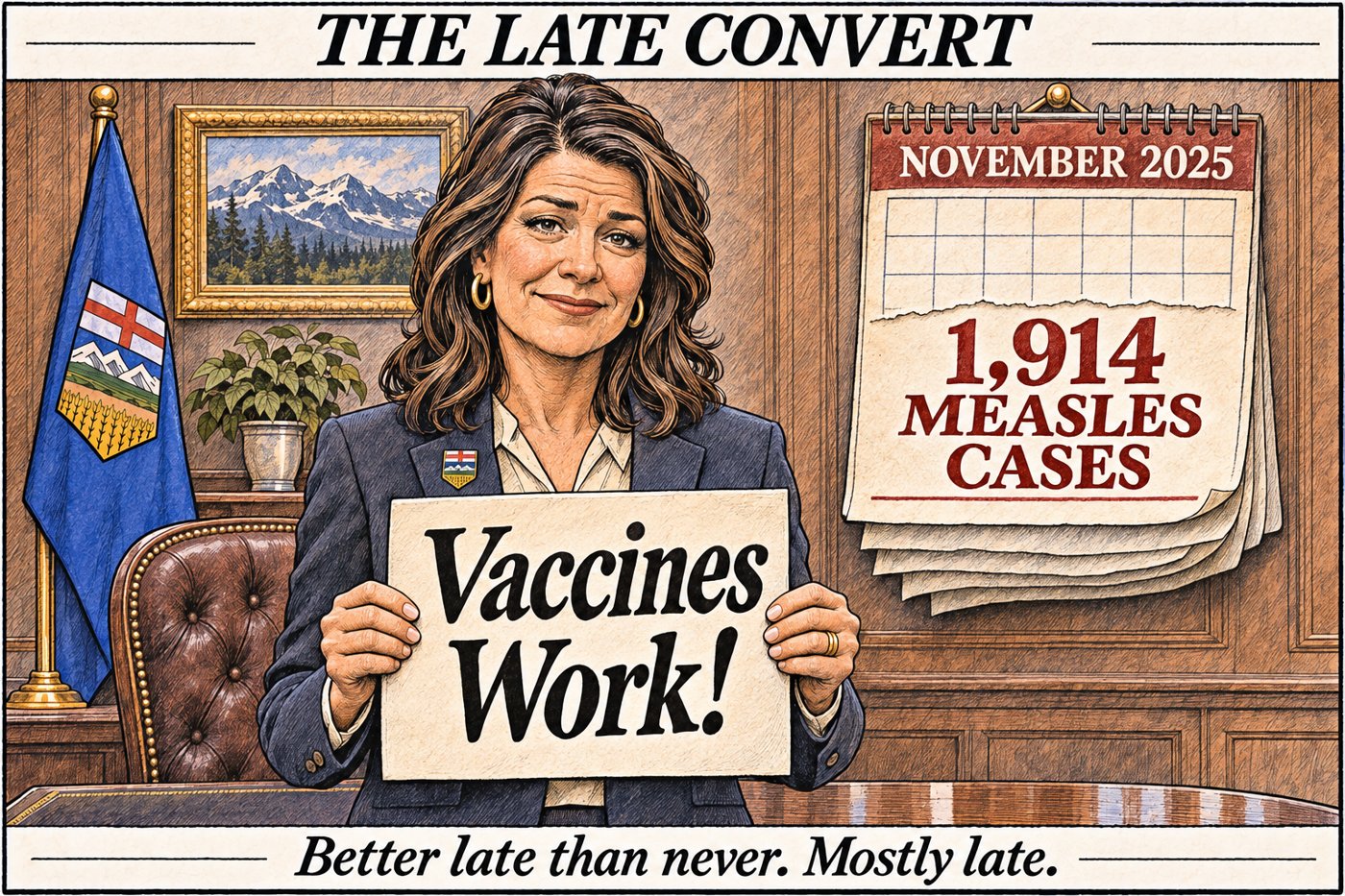
The fair summary: Smith now says plainly that measles vaccination protects children, and her government funds childhood vaccines and has expanded some. But she built her leadership on opposition to vaccine mandates, has never put her own voice behind childhood immunization the way she put it behind the "right to refuse," and wrote that right into provincial law in the middle of falling vaccination rates. In southern Alberta, where every point of coverage matters, that signal counts.
Related QuackeryWatch pages
- Shawn Buckley: The Lawyer Behind the Supplement Lobby (including the Stephan trials and the battle of the pathologists)
- Ezekiel Stephan and the Truehope family
- Before the Vaccines: What I Saw
- Martyrs? Read the Anti-Vax Rap Sheet
- Bill C-224: Should Supplements Escape Vanessa's Law?
Sources
- The Stephans' church and views: Globe and Mail, second trial; Global News, Stephan on why they were charged; Vice, Bigtree interview; Globe and Mail, Caulfield on "martyrs".
- Latter-day Saint position: Church News, 1978 and 2021 First Presidency statements; Deseret News, General Handbook; KSL, August 2021 statement.
- Matkin A, Simmonds K, Suttorp V. Measles-containing vaccination rates in southern Alberta. Canada Communicable Disease Report 2014;40(12).
- Kulig JC et al. Refusals and delay of immunization within southwest Alberta: understanding alternative beliefs and religious perspectives. Canadian Journal of Public Health 2002;93(2):109–112.
- Ruijs WLM et al. Religious leaders and vaccination in an orthodox Protestant minority, BMC Public Health 2013; and orthodox Protestant parents' vaccination decisions, 2012; PMC3434025; Reformatorisch Dagblad, three Dutch pastors on providence; Baptist News Global, Vanderbilt review of denominations.
- Low German Mennonites: Global News / Canadian Press, addressing fear in Alberta's Mennonite community; CTV News, same; Anabaptist World, vaccine suspicion and emigration; Globe and Mail, Taber outbreak.
- 2025 outbreak: CBC, South Zone rates; CBC via Braceworks, 710 cases, worst since 1986; CBC, premature baby dies; Braceworks/CBC, 1,914 cases, 152 hospitalized; CBC, congenital measles, mothers unimmunized; Globe and Mail, death not made public for months; CBC, Alberta 2024 coverage.
- Prosecutions: CTV News, Canadian cases; Globe and Mail, Lovett sentence; Global News, Lovett parole; Global News, Radita verdict; CBC, Radita appeal; Global News, Clark sentence; Lethbridge News Now, Clark church support; Abbotsford News/CP, Clark appeal; CBC, naturopathy review.
- Family courts: Global News, Lethbridge vaccination ruling; CBC, Edmonton ruling.
- Law: Alberta Health Services, measles school-exclusion letter; Global News, 2016 Public Health Act amendment; Legislative Assembly of Alberta, Bill 24 text; Government of Alberta, Alberta Bill of Rights; National Newswatch/CP, no harm exception for vaccines; Law360 Canada, legal commentary.
- Premier Smith: CBC, "most discriminated against group"; Globe and Mail, clarification; Globe and Mail, fall 2023 campaign; CBC, Bill 24 introduction; Troy Media, political silence column; CTV News/CP, LaGrange campaign; CBC, loss of elimination status "concerning"; CBC, RSV for newborns; Western Standard, pharmacy COVID access criticism; Global News, 2026 COVID vaccine eligibility.