"Mcgill_Medicine" Is Not McGill
An anonymous X account borrowed the name of Canada's oldest medical faculty in September 2026. It posts careful-sounding captions on top of ivermectin, fenbendazole and "turbo cancer" videos.
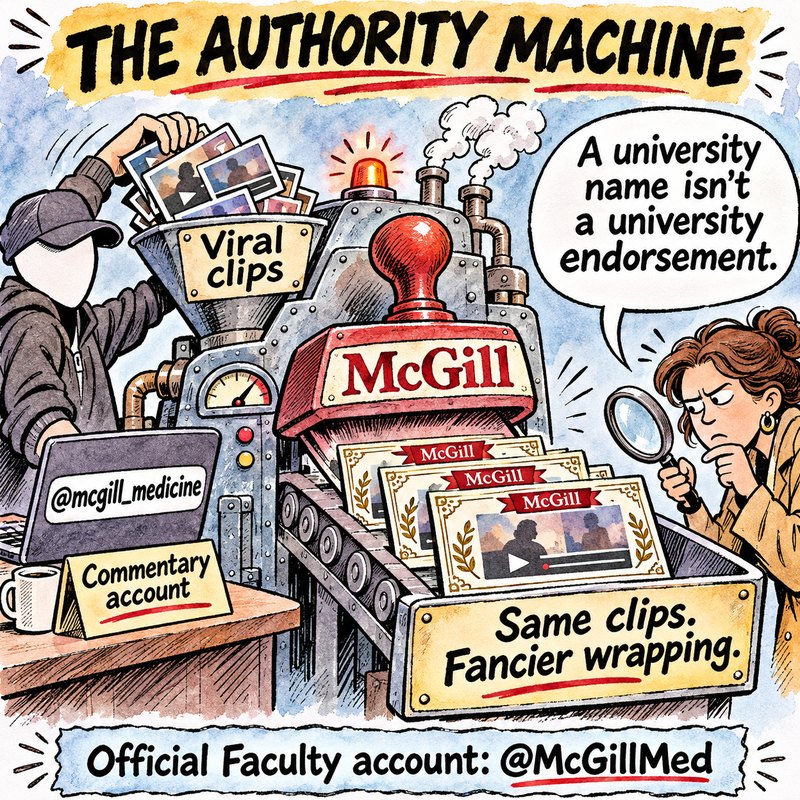
At a glance
| Account | @mcgill_medicine (display name "Mcgill_Medicine") |
| Connection to McGill | None known. McGill's real Faculty of Medicine and Health Sciences account is @McGillMed. |
| Created | September 2026 |
| Labels | Paid blue check; X "Commentary account" label |
| Location shown | "United states" |
| Output | 847 posts by early November 2026, which works out to at least a dozen a day |
| Subject | Almost entirely cancer: ivermectin, fenbendazole, mebendazole, "three-drug protocols", chemotherapy doubts and "turbo cancer" |
| Who runs it | Unknown |
A name that does the persuading
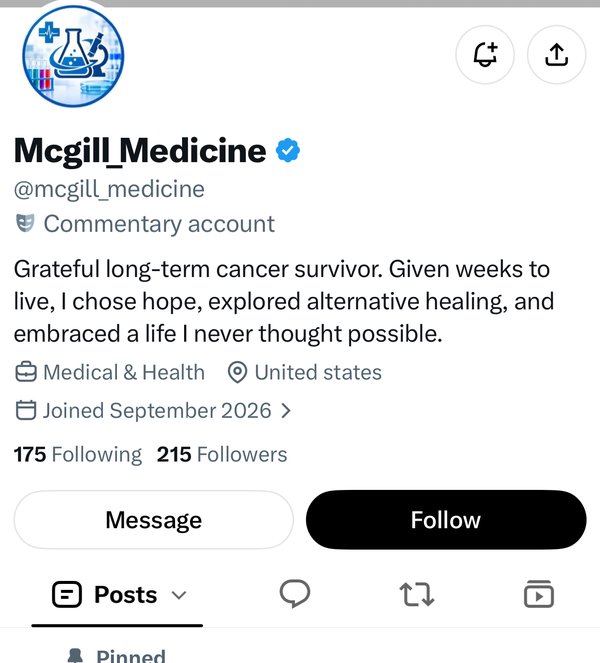
Anyone scrolling past sees "Mcgill_Medicine", a blue check, a round logo with a lab flask and microscope, and a stream of serious-looking cancer posts. Most readers will assume it belongs to McGill University's medical school in Montreal, and it doesn't.
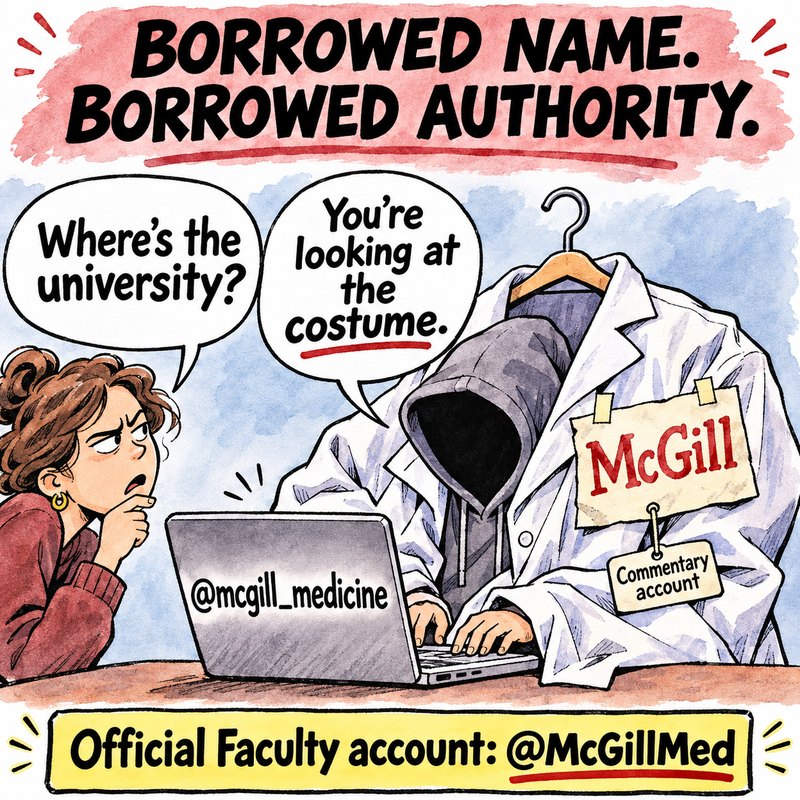
The profile itself gives the game away to anyone who reads it. The bio describes a "grateful long-term cancer survivor" who, given weeks to live, "explored alternative healing." The account sits under X's "Commentary account" label, which is X's label for parody and commentary accounts. The paid blue check verifies only that someone has a subscription, not who they are or what institution they represent.
The method: a careful caption on a promotional video
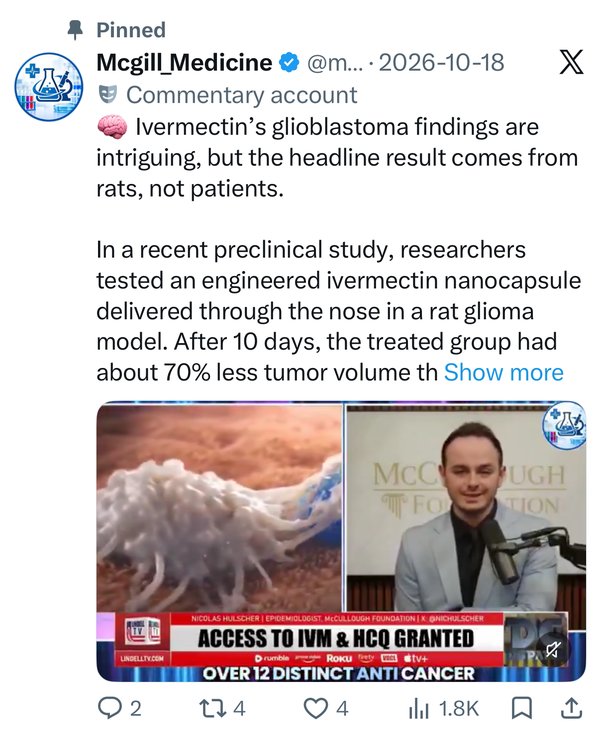
This account is not crude. Its captions are often worded the way a science communicator would write them. Take its pinned post from 18 October 2026, about ivermectin and glioblastoma. Read in full, the caption says the headline result came from rats, used a special nanocapsule sprayed into the nose, says nothing about ordinary ivermectin tablets, and is:
"promising preclinical work, not proof that ivermectin cures cancer."
That is accurate. The video attached to it is something else. It is a Lindell TV segment featuring Nicolas Hulscher of the McCullough Foundation, under the banners "ACCESS TO IVM & HCQ GRANTED" and "OVER 12 DISTINCT ANTI-CANCER…", with the @mcgill_medicine logo stamped in the corner.
What the caption says
Rats, not patients. A special formulation. No human dose established. Case reports can't prove cause.What the video says
"Access to IVM & HCQ granted." "Over 12 distinct anti-cancer…" effects. The full McCullough Foundation pitch.On X, most people watch the video and never tap "Show more" to read the rest of the caption. The video carries the message, and the cautious text gives the account cover if anyone objects. Whether that is deliberate or not, the effect is the same: Hulscher's and Lindell's material reaches a new audience under a name that sounds like a Canadian medical school.
The fenbendazole post
An early-November post asks, "Fenbendazole, mebendazole and MD Anderson: what does the research really show?" The graphic attached to it is a polished image of MD Anderson Cancer Center's sign, with the word "Cancer" crossed out in red. It presents a social-media comment claiming that an MD Anderson researcher "first discovered" mebendazole's anti-cancer activity in 2002, that Joe Tippens "pioneered the human use of FenBen", and how much fenbendazole each gram of Panacur C, a Merck Animal Health dog dewormer, contains.
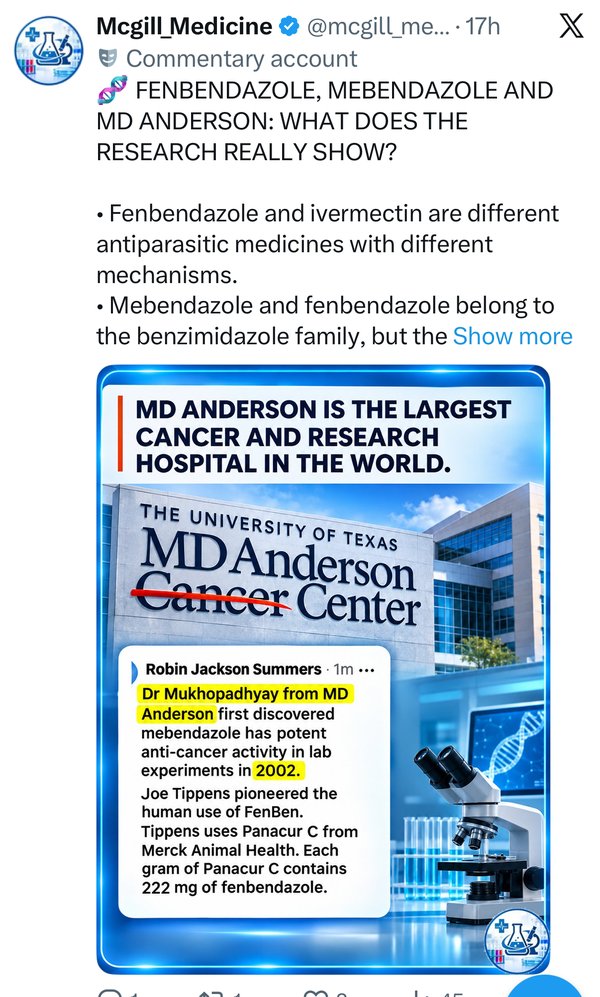
Here is what the graphic leaves out:
- The 2002 paper was about a different drug, and it wasn't tested in patients. Mukhopadhyay, Sasaki, Ramesh and Roth at MD Anderson reported that mebendazole, a human anthelmintic, triggered cell death in lung-cancer cell lines and slowed tumour growth in mice. That is laboratory work. It is not evidence that fenbendazole treats cancer in people.
- Tippens was not taking fenbendazole on its own. By his own account, Tippens was enrolled in an immunotherapy trial at MD Anderson, which Community Notes on X have identified as a Keytruda (pembrolizumab) trial, at the same time as he took the dewormer. One remission in a man receiving a proven cancer drug can't be credited to Panacur C. See our full page on the Tippens Protocol.
- People have been harmed. In 2021 Japanese oncologists described an 80-year-old woman with advanced lung cancer, on pembrolizumab, who developed severe liver injury after a month of fenbendazole she had started on the strength of social-media posts. The injury resolved when she stopped, and her tumour did not shrink.
"Turbo cancer," a campaign rally and chemotherapy doubts
The same pattern runs through the rest of the feed. One post is headlined "Pfizer DNA found in a rare heart tumor? What the 2026 case report really shows." Its video is another Lindell TV segment with Hulscher, branded "BASEBALL-SIZED TURBO HEART CANCER" and "WE'RE NOW FINDING THE WEAPON," with the @mcgill_medicine watermark added.
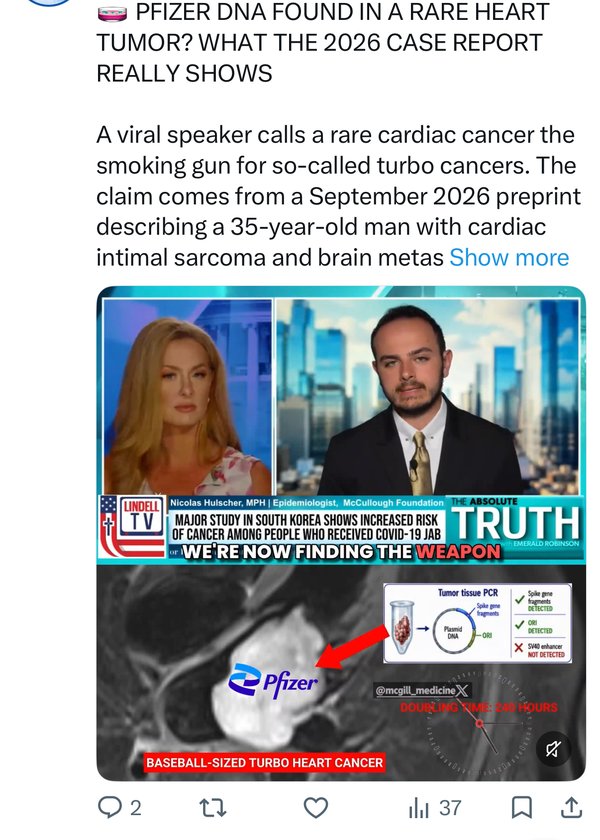
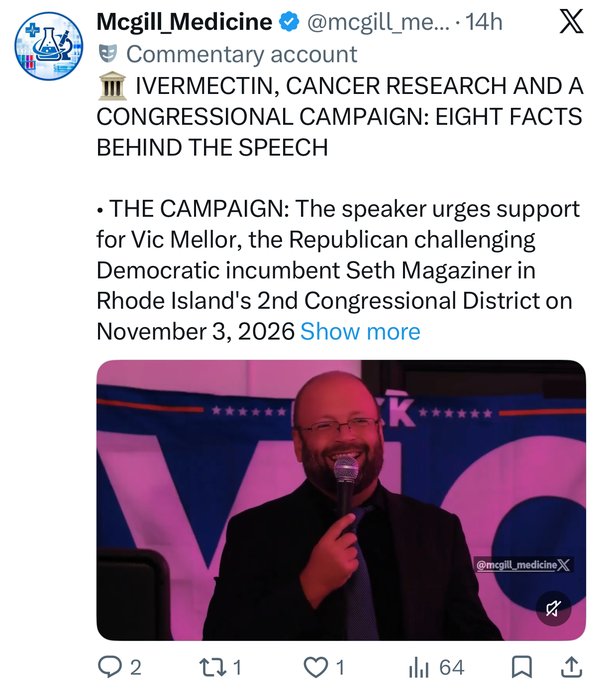
Other recent posts include "Does chemotherapy destroy the immune cells that protect against cancer?" and "Stage 4 esophageal cancer and a three-drug protocol." One links ivermectin and cancer research to a speech at a US congressional campaign event in Rhode Island, with the speaker's video stamped "@mcgill_medicine." That last one has nothing to do with McGill, with medicine, or with Canada.
Bot, or a person?
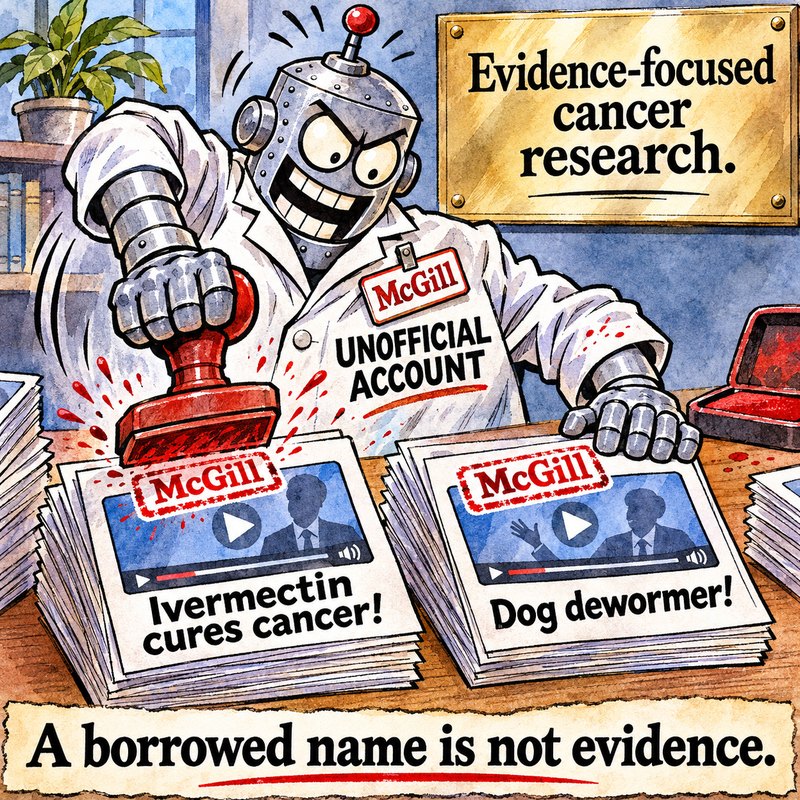
We can't prove the account is automated, but the signs point that way:
- Volume. 847 posts in roughly two months is at least a dozen a day, every day.
- A template. Every post we have seen follows the same recipe: an emoji, an all-caps headline in the form "What X really shows" or "What Y does not prove", bulleted points, a closing line ("Follow @mcgill_medicine for evidence-focused cancer research"), and a block of hashtags.
- Generated graphics. The MD Anderson image has the glossy look of AI-generated art, and every video is stamped with the account's own watermark.
- Little real engagement. Most posts draw a few dozen views and a handful of likes. That fits an account built to post rather than to converse.
High-volume, AI-written "evidence" posts attached to viral misinformation clips are a known engagement-farming pattern on X. Whether there is one person behind this account or something larger, its posting is industrial in scale.
What you can do
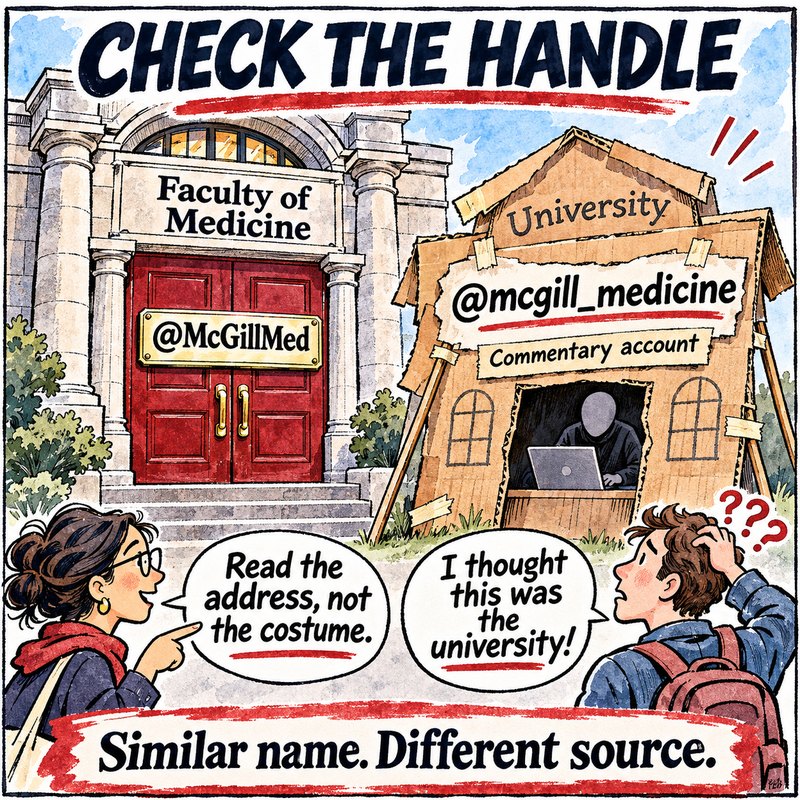
- Check the handle. McGill's Faculty of Medicine and Health Sciences posts as @McGillMed. The underscore account is not McGill.
- Read the whole post, then think about the video. A careful caption doesn't excuse spreading a misleading clip.
- Report it. X lets you report impersonation and misleading identity from the "…" menu on the profile. Only McGill itself can file a trademark complaint.
- Talk to your oncologist before taking ivermectin, fenbendazole or any "repurposed" drug alongside cancer treatment. Liver injury and drug interactions are real risks.
We have alerted colleagues at McGill's Office for Science and Society.
Sources
- @mcgill_medicine profile and posts on X, screenshots captured 4 November 2026.
- Mukhopadhyay T, Sasaki J, Ramesh R, Roth JA. Mebendazole elicits a potent antitumor effect on human cancer cell lines both in vitro and in vivo. Clin Cancer Res 2002;8(9):2963–69. PubMed
- Science Feedback. Lack of clinical evidence for the claim that dog dewormer fenbendazole cures cancer. science.feedback.org
- Yamaguchi T, Shimizu J, Oya Y, Horio Y, Hida T. Drug-induced liver injury in a patient with nonsmall cell lung cancer after the self-administration of fenbendazole based on social media information. Case Rep Oncol 2021;14(2):886–91. PMC
- McGill Medicine and Health Sciences, official X account: @McGillMed