Organizations · Vaccines · COVID-19
AAPS: The Doctors' Group With a Journal Nobody Indexes, and Now a Seat at the CDC
The Association of American Physicians and Surgeons is small, politically conservative and more than eighty years old. Its journal has carried HIV denial, the abortion–breast cancer claim and vaccine–autism claims. It campaigned for ivermectin and hydroxychloroquine for COVID-19. In April 2026 it was named a liaison organization to the committee that shapes the American vaccine schedule.
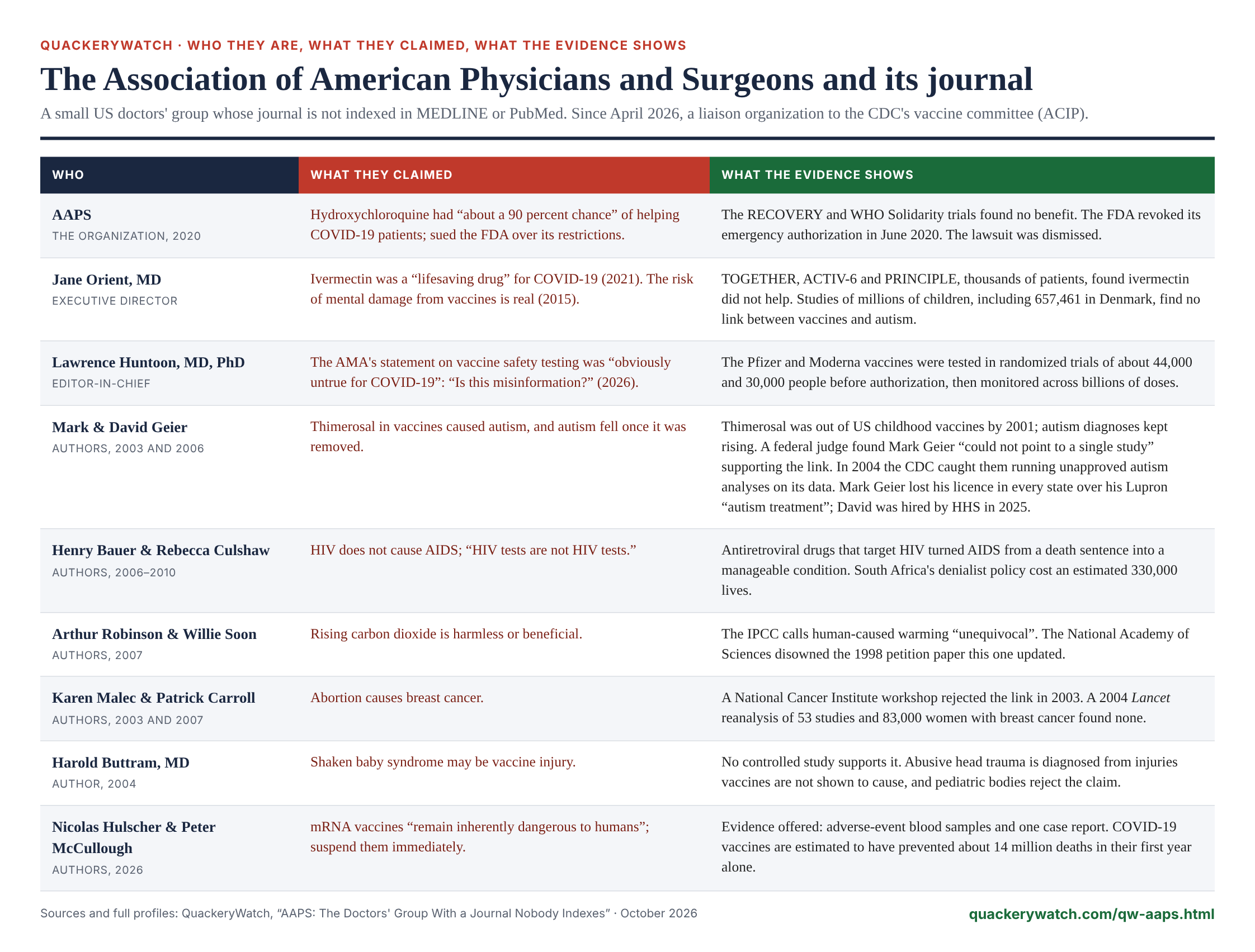
What AAPS says it is
AAPS describes itself as dedicated “to the highest ethical standards of the Oath of Hippocrates” and to preserving “the sanctity of the patient-physician relationship and the practice of private medicine.” Its core positions are economic and political: against government-run health insurance, against third parties standing between doctor and patient, and for the physician's right to prescribe as he or she sees fit. Many doctors who have never read its journal would agree with some of that.
The trouble is what the group has attached to it. “Freedom to prescribe” has become the case for ivermectin. “Parental choice” has become the case against vaccine requirements. And a journal that looks like a medical journal has been used to give fringe claims a citation.
The journal
The Journal of American Physicians and Surgeons has the look of a peer-reviewed medical journal: volume numbers, references, an editorial board. But it is published by an advocacy group, and the main databases doctors use to find medical literature do not carry it. It appeared on Beall's list of potential predatory open-access journals in 2016, and Quackwatch has long listed it among its non-recommended periodicals. The New York Times, profiling the group in 2011, noted that the journal had published articles making claims that mainstream science had discredited.
Over the years the journal has run articles arguing:
- that HIV does not cause AIDS;
- that abortion raises the risk of breast cancer, a link the National Cancer Institute, the American Cancer Society and the World Health Organization all reject;
- that vaccines may be linked to autism. A 2003 paper on vaccine harms drew criticism from the WHO and the American Academy of Pediatrics;
- and that human-caused climate change is doubtful.
Who edits it, and who writes for it
A journal is its editor and its authors. These are some of the people whose work has run in the Journal of American Physicians and Surgeons, and what is on the public record about them.
Lawrence R. Huntoon, MD, PhD
The journal's longtime editor. In AAPS News for July 2026 he answered the AMA's statement that vaccines are “among the most closely monitored medical products in the world” by calling its account of pre-approval testing “obviously untrue for COVID-19” and asking: “Is this misinformation?”
Jane M. Orient, MD
The group's public voice for decades. In 2015, as Senator Rand Paul linked vaccines to “mental disorders”, she told Bloomberg the risk was real because “we have a lot of observations that are not otherwise explainable.” She fronted the 2021 ivermectin press release, and was the media contact on the March 2026 release calling for mRNA vaccines to be suspended.
Mark Geier, MD, and David Geier
The father-and-son team wrote the lead article in the journal's first issue, in 2003, arguing that thimerosal in vaccines caused autism; the American Academy of Pediatrics criticized their thimerosal work that year. A second JPandS paper in 2006 claimed autism diagnoses fell once thimerosal was removed. Mark Geier then treated autistic children with Lupron, a drug used for chemical castration, at ten times the usual dose, alongside chelation. Maryland suspended his licence in April 2011 and revoked it in 2012; by 2013 he had lost his licence in every state where he held one. David Geier, who has a bachelor's degree in biology, was fined $10,000 in Maryland in 2012 for practising medicine without a licence. In March 2025 Health Secretary Robert F. Kennedy Jr. hired David Geier at HHS, reportedly to study vaccine and autism data. In May 2026 Mother Jones reported that HHS still would not say what he was doing there. Mark Geier died in March 2025. Full profile of the Geiers →
Henry H. Bauer, PhD, and Rebecca Culshaw, PhD
Neither is a physician: Bauer is an emeritus professor of chemistry and science studies at Virginia Tech, Culshaw a mathematician. Culshaw's article supporting HIV/AIDS denial ran in the Winter 2006 issue. Bauer's “Questioning HIV/AIDS: Morally Reprehensible or Scientifically Warranted?” ran in Winter 2007 (vol. 12, no. 4), with a favourable review of his own denialist book in the same volume; further Bauer papers in the journal followed, including “HIV Tests Are Not HIV Tests” (2010). This was published while antiretroviral treatment was saving millions of lives, and after South Africa's denialist AIDS policy had cost an estimated 330,000.
Arthur B. Robinson, Noah E. Robinson and Willie Soon
“Environmental Effects of Increased Atmospheric Carbon Dioxide” (vol. 12, no. 3, 2007) argued that rising carbon dioxide was harmless or beneficial. It updated the manuscript Robinson circulated in 1998 with the “Oregon Petition”, formatted to look like a reprint from the Proceedings of the National Academy of Sciences. The Academy issued a statement that it had nothing to do with the petition and that the manuscript had not appeared in any peer-reviewed journal. In 2015 the New York Times reported that Soon had received fossil-fuel industry funding for his research without disclosing it in some of his papers.
Karen Malec and Patrick S. Carroll
Malec's editorial “The Abortion–Breast Cancer Link” (Summer 2003) and Carroll's “The Breast Cancer Epidemic: Modeling and Forecasts Based on Abortion and Other Risk Factors” (Fall 2007) both argued for a link that a National Cancer Institute expert workshop had rejected in 2003.
Harold E. Buttram, MD
A Quakertown, Pennsylvania family doctor (1925–2016) who offered chelation and argued that cases diagnosed as shaken baby syndrome might be vaccine injuries. He testified for the defence in more than 60 infant-death trials, by Arthur Allen's count, and never for the prosecution. He co-wrote a book, Vaccines and Genetic Mutation, with Alan Yurko while Yurko was serving life for the 1999 murder of his 10-week-old son; Yurko was later freed on a new-trial order over the medical examiner's errors and pleaded no contest to manslaughter.
In 1994 the U.S. Attorney's office sued him for balance billing Medicare patients, charging them more than the law allowed. He settled by consent order, paying $49,112.40 back to patients and a $10,000 penalty, without admitting liability, and blamed his billing staff. On 23 June 1998 the Pennsylvania State Board of Medicine found him “guilty of unprofessional conduct” for violating the state's Medicare Fee Control Act and reprimanded his licence (Docket No. 0489-49-97).
His own bibliography lists more than twenty vaccine papers and essays, many on shaken baby syndrome, among them a “Rebuttal to the Joint Statement on Shaken Baby Syndrome” and a 2002 open letter supporting parents who wanted to limit or avoid immunizations. In a 2011 article with Catherine Frompovich he wrote that “vaccines can and do cause a significant percentage of subdural brain hemorrhages which, tragically, are being falsely and unjustly misdiagnosed as inflicted abuse by parent or caretaker,” and claimed that half of infant deaths are attributed to shaken baby syndrome. They are not: the leading causes of infant death in the United States are birth defects, preterm birth and sudden infant death. He was also listed as an editor of Medical Veritas, an anti-vaccine journal, and two blogs that track the anti-vaccine movement describe him as an AAPS member and an adviser to the Medical Voices Vaccine Information Center, which also promoted Dr. Rashid Buttar (no AAPS tie of Buttar's own has been found).
Nicolas Hulscher, MPH, and Peter A. McCullough, MD
Authors, with John Catanzaro, ND, of the spring 2026 paper calling for “immediate and comprehensive suspension” of mRNA vaccines (see above). Hulscher is the source of the “two largest COVID vaccine safety studies” claim; McCullough testified at the Allison Inquiry in Ottawa in September 2026.
COVID-19: hydroxychloroquine and ivermectin
AAPS was one of the earliest and loudest medical voices for both drugs.
- 2020 — AAPS sued the FDA in federal court in Michigan over its restrictions on hydroxychloroquine. The court dismissed the case: the injuries AAPS claimed for itself, its members and their patients had no causal connection to anything the FDA had done.
- 15 January 2021 — When the NIH treatment panel moved from recommending against ivermectin to saying the data were insufficient either way, AAPS issued a press release “applauding” the change. It cited 49 favourable studies tallied on an advocacy website and a Buffalo patient who had the drug restarted only after a judge ordered it. “Perhaps with this change,” said Orient, “patients won't need a court order to get a lifesaving drug.”
- 2022 — AAPS filed an amicus brief in Apter v. HHS, the suit by Drs. Robert Apter, Mary Talley Bowden and Paul Marik over the FDA's “you are not a horse” messaging. Schlafly said the FDA had “engaged in a campaign of interference with the proper use by physicians of ivermectin.”
- March 2024 — The FDA settled Apter by taking down the posts. It admitted no wrongdoing and said its position had not changed: clinical-trial data do not show ivermectin works against COVID-19.
By then the question had been answered. The large randomized trials (TOGETHER, ACTIV-6 and the UK's PRINCIPLE, thousands of patients in all) found that ivermectin did not help people with COVID-19 recover. Hydroxychloroquine had failed in the RECOVERY and WHO Solidarity trials in 2020. The full story, including the Canadian prescribers disciplined over ivermectin, is on this site's ivermectin page.
Suing medicine's own standard-setters
AAPS litigates often, against governments and against the profession's own institutions.
- 1993 — With other groups, sued Hillary Clinton's health-care task force over the secrecy of its membership. An award of $285,864 in their favour was overturned on appeal.
- 2013–2020 — AAPS v. American Board of Medical Specialties alleged a conspiracy over the use of board certification by hospitals and insurers. The federal court in Chicago dismissed it twice, the second time with prejudice, in 2020.
- 2014 — A suit to strike down the Affordable Care Act was dismissed for lack of standing.
- 2022– — AAPS Educational Foundation v. American Board of Internal Medicine. AAPS sued the internal-medicine, family-medicine and obstetrics boards after they warned certified doctors that spreading COVID-19 misinformation could cost them their certification. The trial court in Texas dismissed it. On 3 June 2024 the Fifth Circuit revived the First Amendment claims on standing and sent the case back, without ruling on the merits. Dr. David Gorski called the suit “legal thuggery against medical standards.”
The common thread is that the boards, the FDA and the hospitals are presented as the threat to good medicine, and the doctor who departs from the evidence as its defender.
April 2026: a seat at the vaccine table
ACIP advises the CDC on which vaccines Americans should get and when. Its votes set the childhood schedule and decide what insurers must cover. In June 2025 Health Secretary Robert F. Kennedy Jr. dismissed all seventeen members and appointed his own. On 16 March 2026 a federal judge, Brian Murphy, stayed the committee's major changes, including the revised childhood schedule, in American Academy of Pediatrics v. Kennedy.
Rather than appeal at once, the administration rewrote the committee's charter. A revised charter published on 6 April 2026 added AAPS to ACIP's list of liaison organizations: groups that sit in on meetings and contribute to the work, without a vote. Added with it were the Independent Medical Alliance, which is the renamed FLCCC Alliance, the group that built its name on ivermectin; Physicians for Informed Consent; and the Medical Academy of Pediatrics and Special Needs. CIDRAP reported that all of them had documented vaccine-sceptical positions. The April charter was withdrawn and replaced by one Kennedy signed on 19 May, but AAPS kept its seat: the charter on the CDC's website, last updated 24 June 2026, lists it among 33 liaison organizations. The American Academy of Pediatrics and the Infectious Diseases Society of America are still on that list; the American College of Obstetricians and Gynecologists, which withdrew in February, is not. “What [Kennedy] is doing is incredibly dangerous,” said Dr. Paul Offit.
One name on the same list should interest Canadians: Canada's own National Advisory Committee on Immunization (NACI) is also an ACIP liaison. It now shares that table with AAPS.
The traffic runs both ways (the full roll call is in The Not Ready for Prime-Time Players). At AAPS's 83rd annual meeting, in Alpharetta, Georgia, 24–26 September 2026, the vaccine session was given by Dr. Kirk Milhoan, listed by AAPS under ACIP, and Dr. Bob Sears, the California pediatrician the Medical Board of California placed on probation in 2018 over a vaccine exemption he wrote for a two-year-old.
Why this is on a Canadian site
AAPS has no Canadian chapter, but its material does not need one. Its press releases, its journal articles and now the ACIP decisions it helps shape are shared on Canadian social media within hours. The same names turn up here in person: McCullough at the Allison Inquiry on Parliament Hill, ivermectin sold by telehealth to Canadians. Canada lost its measles-elimination status in November 2025. When an American committee that advises on vaccines takes advice from a group whose journal has carried vaccine–autism claims, Canadian parents hear about it too.
The one thing to remember about the journal is the simplest: if a claim's only source is the Journal of American Physicians and Surgeons, look for the same finding in an indexed journal. If it is not there, ask why.
What the press has said about AAPS
Coverage has been sporadic, usually when the group crossed paths with a political story. No mainstream outlet has investigated it in depth since 2009, and none has yet examined how it came to sit on ACIP.
- 2009 · Mother Jones — Stephanie Mencimer, “The Tea Party's Favorite Doctors.” The closest thing to a full exposé: the group's politics, its journal and its fringe science, written as it campaigned against health reform.
- 2009 · Talking Points Memo — “MoJo Turns Spotlight On Far-Right Doctors' Group.” A follow-up drawing wider attention to the Mother Jones story.
- Media Matters — “Note to media: AAPS is a right-wing group with fringe views.” A warning to reporters who were quoting AAPS as if it were a mainstream medical body.
- 2011 · New York Times — “Vocal Physicians Group Renews Health Law Fight,” online 18 January 2011, in print the next day. A profile during the Affordable Care Act fight, noting the journal's discredited claims. The media-watch group FAIR criticized the Times for giving AAPS the space: “No Room in NYT for Single-Payer Doctors, but Right-Wing Cranks Are OK.”
- 2015 · New York Times — Jeremy W. Peters and Barry Meier, “Rand Paul Is Linked to Doctors’ Group That Supports Vaccination Challenges,” 5 February 2015. Written after Senator Paul linked vaccines to “mental disorders” during that year's measles outbreak.
- 2015 · Bloomberg — “Rand Paul and the Anti-Vaxxers of the Right,” 4 February 2015. On Paul's long association with AAPS, and Jane Orient's comment that the risk of mental damage from vaccines is real because “we have a lot of observations that are not otherwise explainable.”
- 2015 · DeSmog — John Mashey, “Anti-Science Associations: Rand Paul, Jane Orient, Art Robinson, Willie Soon and Friends,” 23 February 2015. A detailed map of AAPS's people and its overlap with climate-change denial.
- 2015 · Mother Jones — “Cruz aide briefs fringe doctors group.” A Ted Cruz staffer briefing AAPS on the Supreme Court's Affordable Care Act case.
- 2016 · Wired — Issie Lapowsky, 23 September 2016, on AAPS-linked doctors spreading claims about Hillary Clinton's health during the election.
- 2020 · The Guardian — “The US doctors taking Trump's lead on hydroxychloroquine – despite mixed results.” AAPS among the doctors promoting the drug; the group had claimed it had about a “90 percent chance” of helping COVID-19 patients.
- 2022 · Respectful Insolence — David Gorski, “AAPS joins the legal thuggery against medical standards.” One of many pieces by the surgical oncologist and editor of Science-Based Medicine, here on the lawsuit against the specialty boards.
- Reference — SourceWatch and Wikipedia keep running profiles of the group, its people and its positions.
Related on QuackeryWatch
Sources
- “Association of American Physicians and Surgeons.” Wikipedia, consulted 27 October 2026, and the sources it cites, including “Vocal Physicians Group Renews Health Law Fight,” New York Times, 18 January 2011, and Stephen Barrett, “Nonrecommended Periodicals,” Quackwatch.
- “About AAPS.” AAPS News, July 2026.
- “COVID mRNA Vaccines May Alter Gene Expression, according to Journal of American Physicians and Surgeons.” AAPS press release, GlobeNewswire, 9 March 2026.
- “Harold Buttram, MD, FAACP.” Online bibliography of his writings, captured 27 October 2026 (QuackeryWatch archive).
- “#46: Harold Buttram.” Encyclopedia of American Loons, 30 July 2010; and “Harold E. Buttram, MD.” Encyclopedia of the Anti-Vaccine Movement, March 2014.
- Pennsylvania State Board of Medicine. Commonwealth v. Harold Eugene Buttram, M.D., Docket No. 0489-49-97, File No. 94-49-01884, Consent Agreement and Order, 23 June 1998 (QuackeryWatch archive).
- David Gorski. “The antivaccine lie that just won't die: Shaken baby syndrome is really due to vaccine injury.” Science-Based Medicine, 8 October 2012.
- David Gorski. “The Journal of American Physicians and Surgeons: Ideology trumps science-based medicine.” Science-Based Medicine, 23 June 2008. (Source for the Geier, Culshaw, Bauer, Malec, Carroll and Buttram articles and Huntoon's role.)
- “JPANDS and HIV denialism.” Denialism Blog, ScienceBlogs, 1 April 2008.
- “Mark Geier.” Wikipedia, consulted 27 October 2026, and the licensing records it cites; “Suspension of Mark Geier is upheld,” Left Brain Right Brain, April 2012.
- Anna Merlan. “HHS Refuses to Say What an Anti-Vaccine Activist Is Doing at the Agency.” Mother Jones, 21 May 2026.
- “Oregon Petition.” Wikipedia, consulted 27 October 2026, including the National Academy of Sciences statement of 1998.
- Justin Gillis and John Schwartz. “Deeper Ties to Corporate Cash for Doubtful Climate Researcher.” New York Times, 21 February 2015.
- “Courts Reject Demands to Force FDA to Approve Hydroxychloroquine for COVID-19.” FDA Law Blog (Hyman, Phelps & McNamara), 1 October 2020.
- “AAPS Applauds NIH Revised Stance on Ivermectin for COVID-19.” AAPS press release, 15 January 2021.
- “Association of American Physicians and Surgeons: FDA Misled the Public About Ivermectin.” Legal Insurrection, 4 October 2022 (AAPS amicus filing in Apter v. HHS).
- “FDA settles ivermectin lawsuit, removes contentious COVID-19 posts.” BioPharma Reporter, 2 April 2024.
- “Statement on the Dismissal of AAPS v. ABMS.” American Board of Medical Specialties, 6 October 2020.
- AAPS Educational Foundation v. American Board of Internal Medicine, No. 23-40423. U.S. Court of Appeals for the Fifth Circuit, 3 June 2024.
- David Gorski. “AAPS joins the legal thuggery against medical standards.” Respectful Insolence, 15 July 2022.
- “New ACIP charter: broader membership, focus on vaccine injuries.” STAT, 9 April 2026.
- “New ACIP charter could allow RFK Jr. to further restrict vaccine access, critics say.” CIDRAP, April 2026; and “The State of US Vaccine Policy,” CIDRAP, 16 April 2026.
- “ACIP Charter.” Centers for Disease Control and Prevention, page last updated 24 June 2026 (list of liaison organizations).
- “(Another) New ACIP Charter.” The Unbiased Science Podcast, 28 May 2026 (April charter withdrawn, replaced 19 May).
- “Independent Medical Alliance Named Liaison to CDC's ACIP Vaccine Committee.” PR Newswire, 10 April 2026.
- “Sept 24–26, 2026: AAPS 83rd Annual Meeting.” AAPS, program.
AAPS's own descriptions of itself are quoted from its publications. Characterizations of its journal are attributed to the bodies that made them. Corrections are welcome and are recorded on the page.