From the Archive · Toronto · 18 March 2000
Hulda Clark at Total Health 2000: “We Could Turn That Baby Around”
On a Saturday afternoon in March 2000, at the Consumer Health Organization's Total Health show in the Metro Toronto Convention Centre, Hulda Clark gave a talk billed as “The Cure for All Advanced Cancers.” She spent most of it on one case: a limp, feverish five-year-old with metastatic bone cancer, whom her Tijuana clinic decided not to send to the emergency room. About 1,200 people gave her a standing ovation. I was in the audience with a video camera. This is what she said.
The demonstration
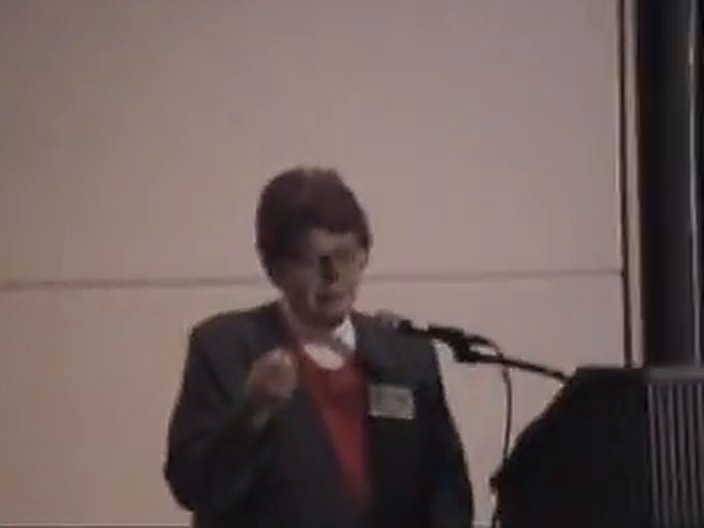
Clark opened with her Syncrometer, the homemade circuit she said could detect any parasite, bacterium or toxin in a person by sound. She tested a volunteer for a copper penny: “Now I'm going to throw a switch, which puts this copper penny in the circuit, and then we'll see if she has it on her. Sounds the same. So I would say she does not have it on her.” She encouraged the audience to start by looking for things in themselves. What the Syncrometer actually is — and why it detects nothing — is set out on The Zapper & Syncrometer.
“She will never come out”
Then she put the planned talk aside. “Something happened that stole my heart away last weekend,” she said, and she read from the clinic file of a five-year-old girl brought to her in Tijuana the Saturday before.
By Clark's own account, the child was not alert. Her body was limp, her head hung to one side, she had not eaten or drunk anything for two days, she had been vomiting for a week before that, and she had had a fever for two weeks. Clark's first thought was the right one: “We should immediately send her to the emergency room because it didn't look as though she had a few days left.” Then (tape 17:17):
The file, she read (about 20:30): “Child, female, age five. Ewing sarcoma with metastasis into the bone marrow.” Chemotherapy, radiation and surgery, she told the audience, were all out of the question. “She had no chance.” There was “no need to do any scans.” Because the child could not be tested by hand, the clinic took a saliva sample, “maybe half the size of a dime or less,” in a plastic baggie and ran it through the Syncrometer instead.
What the clinic gave her
Over the next four days, by Clark's account, the clinic treated what the Syncrometer “found” in the saliva: salmonella, flu, yeast, a sorghum fungus, staphylococcus, large flukes in three bones of the skull, cobalt, lead, asbestos and food dyes. The treatments she described:
- Lugol's iodine, three drops in an eighth of a cup of water, poured down by the mother.
- Digestive enzymes, to “digest” the fungus from flukes killed in the bone.
- Penicillin: “We ran next door, got some penicillin, made it up for her and gave her a teaspoon.”
- The zapper (24:15): “We put the mother in our zapping chair and gave the mother some insulation, two baggies like this, to hold the child's hands onto the electrodes.”
- A homeopathic flu remedy (Oscillococcinum).
- IP6 and inositol, to remove “cobalt.”
- A vitamin B12 injection (30:45), given without warning the child: “This German doctor thought the child should be told. I thought the child should not be told because once she's screaming and trying to get away, we'd never get the needle in her. And I won the battle.” The dose was “5,000 micrograms … five times an adult dose.”
- A 24-inch fluorescent tube, held by family members over the child's bones “10 minutes everywhere,” to take “ferritin” off her white blood cells; and levamisole, for the same purpose.
- Powders of echinacea, hydrangea and sodium selenite; hydrochloric acid added to all her food; iron, vitamin B2 and magnesium before each meal.
She did not mention fluids, a drip, or any test of the child's salts, blood sugar or kidneys. She also told the audience the family had been warned: if the child would not eat by seven that evening, “she had to go to the emergency room. And we didn't tell her the implication.”
“That's the promise”
By Wednesday, Clark said, the girl was “running up and down the hall.” Her mother had found about twenty flukes in her first bowel movement; Clark had pickled them and brought them to Toronto in a jar, and invited the audience to come and look. The Syncrometer now read negative at the tumour. Then the line the talk was built around (38:00):
She announced a Syncrometer workshop for the next afternoon “for those who want to dig into it.”
I am a pediatrician. What Clark described in her first two minutes is a medical emergency: a five-year-old who is limp, not alert, has taken nothing by mouth for two days and has had a fever for two weeks is at risk of dying from dehydration, infection or the cancer itself within hours. The first thing any emergency department would do is give her fluids and find out what is wrong with her blood. Clark's clinic decided against that because, in her words, if the child went to the emergency room “she will never come out.”
Her claim that chemotherapy was impossible is false. Ewing sarcoma, even when it has spread to the bone marrow, is treated with intensive chemotherapy, and some of those children are cured. A Syncrometer reading of saliva in a plastic bag is not a diagnosis of anything. Flukes do not live in the bones of the skull. And no one in that hall was told what happened to this child after the Wednesday Clark last saw her. A talk that ends “we could turn that baby around” without a single follow-up is not a case report. It is an advertisement.
“MDs keep them full”
Clark closed with an appeal to everyone in the room who was not a medical doctor (40:50):
PhDs, dentists, chiropractors, nurses, “health food store nutritionists” and massage specialists, she said, could “bring back the health of Western society” by training themselves in physiology and “the simple wisdom of ancient healing” — “I didn't say get trained by the medical profession. They don't need that.” Her last line: “With something as non-invasive as intelligence, how can you do any harm?”
The ovation, the roses, and the minder
The hall stood and applauded. The moderator asked the crowd to stay put (about 45:40): “Please do not come up and talk to Hulda Clark.” Questions would be taken that evening in another room, and she would be signing books at her booth. Then (about 46:00): “We want to present her with these roses and thank her so much.”
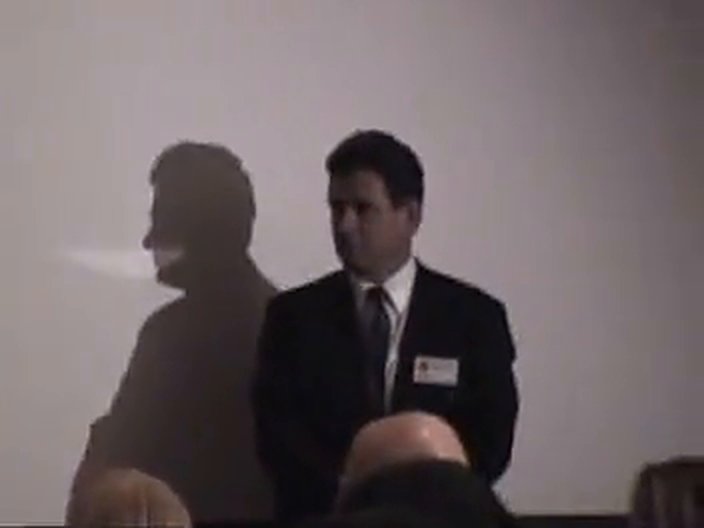
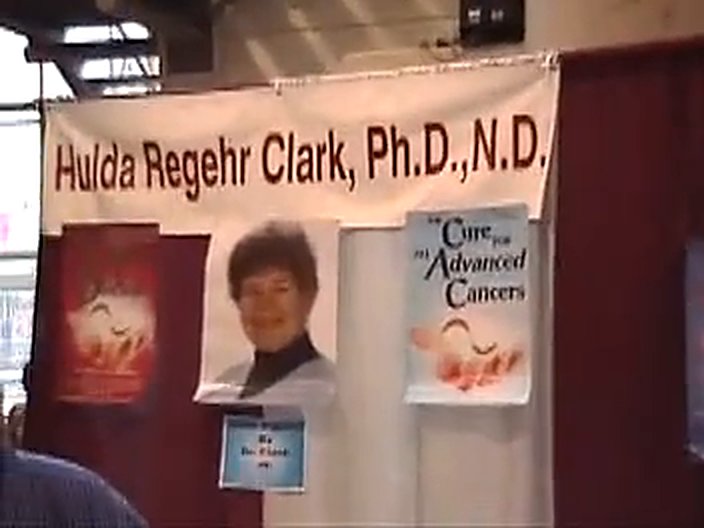
Throughout the talk, Clark's publicist and spokesman Tim Bolen stood near the stage. Bolen went on to lead the campaign against her critics, including me and Dr. Stephen Barrett; see the Bolen/McPhee campaign. On the show floor her booth sold her books under the banner “Hulda Regehr Clark, Ph.D., N.D.” and the title of the day's talk, The Cure for All Advanced Cancers.
What followed
Two months later I described this talk on PBS, in the rebuttal to Clark's appearances on Tony Brown's Journal; see Answering Hulda Clark on PBS. In 2004 the US Federal Trade Commission obtained a judgment against the sellers of her devices. Clark died at home in Chula Vista, California, on 3 September 2009; her death certificate lists multiple myeloma, a blood cancer, as a significant condition. The record of her patients is on Hulda Clark's patients.
Related on QuackeryWatch
Sources
- Terry Polevoy. Video recording of Hulda Clark, “The Cure for All Advanced Cancers,” Total Health 2000, Metro Toronto Convention Centre, 18 March 2000. QuackeryWatch archive; full video on Google Drive. Tape times are approximate.
- Consumer Health Organization of Canada. Total Health 2000 speaker schedule and programme book, March 2000. QuackeryWatch archive.
- Tony Brown's Journal, “Hulda Clark Rebuttal,” parts 1 and 2, PBS, May–June 2000. Transcripts, QuackeryWatch archive.
- County of San Diego. Certificate of death, Hulda Regehr Clark, 2009. See Hulda Clark's patients.
Clark's statements about the child, her treatment and her progress are Clark's own account, given to a paying audience; no independent record of the case has been found. The child is not named. Corrections are welcome and are recorded on the page.